Human Hearing Physiology November 21, 2008
Posted by ConnorSmith in : Acoustics, General Announcements , trackbackOk, I know.
This academic stuff is a tough sell.
But! As boring as this stuff can be, its really important. I’m going to breakdown the complicated human hearing system into three parts to give you a basic understanding of what’s going on. I’m writing this article as sort of a preface to some upcoming posts (about things like safe listening levels and how to protect your hearing). Honestly, if you are working in audio, you should have a basic understanding of your own hearing system.
It’s best to think of the human hearing system as having 3 distinct sections: The Outer Ear, Middle Ear and Inner Ear. (click for fullsize pic)
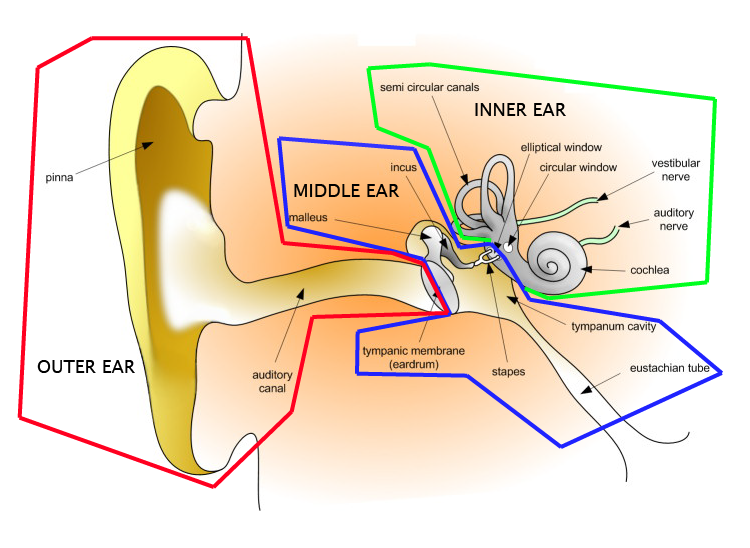
(“Ear.” Wikipedia.org. 20 Nov. 2008 <http://en.wikipedia.org/wiki/ear>. Colored lines added)
The Outer Ear (RED)
The outer ear is comprised of the Pinna (the outer part of the ear), the Auditory canal (ear canal), and the surface of the tympanic membrane (ear drum). The Pinna directs sound into the auditory canal, which in turn begins to vibrate the ear drum. Simple enough right? Its good to note that at this point, the energy from sound is acoustic energy until it hits the ear drum (tympanic membrane)
The Middle Ear (BLUE)
The middle ear is made of the tympanic membrane and the ossicles (three bones of the middle ear: malleus, incus, and stapes). There are other parts to consider (Eustachian tubes, labrinyth, etc…), but the ones I listed are the most important. The middle ear’s job is to convert the acoustic energy coming in from the outer ear into mechanical energy. The ear drum (or tympanic membrane) moves back and forth, causing the three bones to vibrate in turn. The final bone, the stapes, is connected to the inner ear (at the oval window) where the energy will be converted into electrical.
The Inner Ear (GREEN)
The inner ear is the most complicated part of the ear. Its most important parts (for this discussion) are the oval window, the cochlea, and the basilar membrane (which is located inside the cochlea). We know the stapes connects to the cochlea at the oval window, vibrating it back and forth. The cochlea is a spiraled, fluid-filled bone cavity. Running the length of the cochlea (inside) and dividing it lengthwise is a thin membrane called the Basilar Membrane. On the basilar membrane, you will find thousands of tiny hairs, which are one of the most important parts of our hearing system. The hairs, among other things, aid in the process of translating the mechanical energy into electrical, which can then be sent to the brain. The vibrating stapes causes the fluid to vibrate, which excites areas of the basilar membrane. The basilar membrane also responds to frequencies at different areas along its length (more high frequencies at one end, more lows at the other).
Phew! Got through it. Here’s a summary
- Sound comes in ear, makes the ear drum vibrate. Ear drum vibrates the 3 bones (ossicles) of the middle ear. The last bone (stapes) pushes in and out on the cochlea (at the oval window). The now vibrating fluid inside the cochlea excites the basilar membrane (and the hairs on it), and transmits that data to the brain.
In upcoming articles, there may be some references to information in this article (such as when I do the article on protecting yourself form hearing damage).
If you have any questions on the material here, OR if you would like deeper information on any part of the hearing system, please post in the comments.
C
The Studio Files
Comments»
Will u please elaborate about what receives the message first in the inner ear, is it the bony lebirynth or membranous?
Then please go deeper about how does the impulses channelled from the oval window- as in step by step.
Thank u in advance